
Here’s What You Need to Know
Transporting firearms into and within New South Wales (NSW) requires strict adherence to state legislation to ensure safety and compliance. Whether you’re travelling within the state or relocating from interstate, understanding the legal requirements is essential. This guide provides an overview of the key regulations, procedures, and practical steps to stay compliant with NSW law.
Legal Foundations
Under Section 39 of the Firearms Act 1996, anyone in possession of firearms must take all reasonable precautions to ensure they remain secure, are not lost or stolen, and do not fall into unauthorised hands.
These rules apply whether transporting firearms for personal use, competitive shooting, or professional purposes.
Part 1: Travelling with firearms in NSW
Category-Specific Transport Rules
Category A & B Firearms
• Must be unloaded.
• Cannot be visible from outside the vehicle.
• Must comply with safe‐storage standards during transit.
Category C, D & H Firearms
• Must be unloaded; ammunition must be stored separately in a locked container.
• Firearms must be rendered temporarily inoperable (e.g., bolt removed or trigger lock in place), or kept in a locked, vehicle-secured container.
• Ammunition must be in a locked container separate from the firearm (e.g., locked glovebox), and not stored loosely.
Commercial Transportation
• Firearms must be concealed in a locked container secured to the vehicle or in a locked compartment.
• Reasonable precautions must be taken to prevent loss or theft.
Exemptions
Certain exemptions exist for primary producers, employees of land management agencies, or those engaged in vermin control, but only when there is a reasonable likelihood they will need the firearm for these purposes.
Tips for Safe Travelling with Firearms in NSW
• Always transport firearms unloaded and concealed.
• Use trigger locks, remove firing mechanisms, or secure in locked containers depending on the firearm category.
• Store ammunition separately in locked storage.
• Commercial handlers must take extra precautions to prevent loss or theft.
• Exemptions apply in limited circumstances connected with agricultural or pest-control roles.
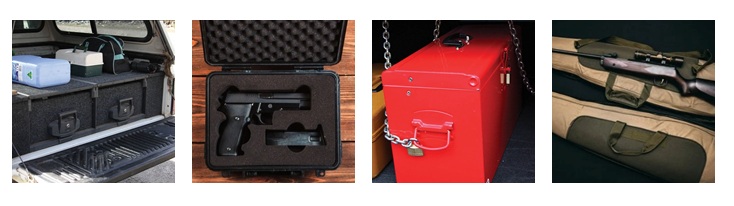
Part 2: Moving to NSW with Firearms
Relocating to NSW with firearms from another state adds extra steps to ensure compliance.
1. Understand Your Current Licence
• If you hold a current interstate firearms licence equivalent to NSW Category A or B, you’re allowed to possess and use those firearms for up to three months from notifying NSW of your move.
• For Category C, D, and H licences, this grace period is seven days—after which you may possess, but not use, the firearms while your NSW application is in process.
2. Notify the NSW Firearms Registry in Writing
• You must notify your intention to move—either through a formal application or written notification—to take advantage of the grace period.
3. Apply for a NSW Firearms Licence

Submit an online application via the NSW Police Force Community Portal.
You’ll need:
• A MyServiceNSW account
• Proof of identity
• Details of your interstate licence (number, expiry, issuing state/territory)
• Firearm details and supporting documents for your “genuine reason”
• Payment, if applicable
4. Register Your Firearms Locally
Have a licensed NSW firearms dealer inspect your firearms and complete a P558 Register of Firearms in Possession form. Attach this to your application to avoid delays—or potentially seizure— by police.
5. Fees & Exemptions
Registration fee: $10 per firearm, with exemptions for pensioners or primary producers (proof required).
If your interstate licence is not current, you must:
• Apply for a Permit to Acquire (PTA) per firearm ($30 each)
• Surrender or arrange safekeeping via a dealer while awaiting your NSW licence.
6. Surrendering Unregistered Firearms
Possession of an unregistered firearm is an offence under the Firearms Act 1996. If you find yourself in possession of an unregistered firearm, you should immediately surrender it to NSW Police or a licensed firearms dealer. The dealer can assist with registration and ensure the firearm is held securely while your Permit to Acquire (PTA) and licence application are processed. Acting promptly can help avoid potential legal consequences.
7. No Need for Re-Testing (Provided Licence is Current)
If you provided timely notification and your interstate licence is current, you are not required to complete another firearms safety training course in NSW.
Quick Reference Checklist:
Transport firearms unloaded and concealed.
• Store ammunition separately and securely.
• Notify NSW Police when moving from interstate.
• Submit NSW licence applications promptly.
• Work with a licensed NSW firearms dealer to register firearms.
• Understand grace periods for using firearms from interstate licences.
• Surrender any unregistered firearms immediately.

Moving to or travelling within NSW with firearms doesn’t have to be stressful. Document your move early, follow the relevant transport rules, and comply with NSW licencing and registration requirements. Acting within the legal framework ensures both safety and a smooth transition.