The Same Side of the Table
I spent a good part of my working life in rooms where people who agreed on ninety per cent of things spent all their energy on the other ten. Parliament does that to you. It rewards difference, because difference is how you get noticed, and it quietly punishes the people who go looking for common ground.
I do not want that habit anywhere near our sport, and this week I want to explain why.
There is no such thing as a win for one of us
Australia has a lot of shooting organisations. There are the big member associations, the discipline bodies, the collectors, the field and game people, the dealers, the importers, the range operators and the manufacturers. We have different constitutions, different members, different priorities and, from time to time, different views on tactics.
None of that matters to the people who write firearms law.
When a government decides to move on licensed firearms ownership, it does not sit down and work out which association deserves to be spared. It moves on the category, the classification or the licence condition, and every one of us wearing that licence wears the consequence. A reclassification that lands on a collector lands on a competitor holding the same platform. A storage change written with one group in mind applies in every home in the state. There is no version of this where one organisation gets looked after while the rest go under.
We are not competing associations. We are one constituency with different logos.
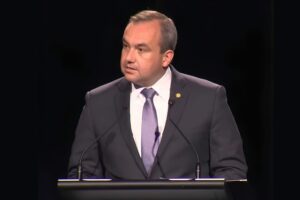
Image : NSW Health (YouTube)
What division actually costs
Here is the part I can speak to with some authority, having sat on the other side of the desk.
When a minister or an adviser receives four submissions from four organisations saying four different things, the practical effect is not that our case is heard four times. The practical effect is that the adviser writes a note saying the sector is divided, and the file moves on. Division does not weaken our argument. It removes the need for anyone to answer it at all.
Worse, it hands the decision to whoever is most convenient to deal with. A government that can find one group willing to accept a compromise will point at that group and describe the deal as consultation. I have watched it happen, in this policy area and in others, and it is always the same shape.
The inverse is also true, and it is the more useful lesson. When every organisation in the sector says the same thing in the same week, the cost of ignoring it goes up sharply. Not because of the volume, but because a unified position is much harder to characterise as a fringe complaint.
Unity is not agreement
I want to be careful here, because unity is often used as a word that means fall into line, and that is not what I am asking for.
We will not agree on everything, and we should not pretend to. Different associations serve different members and owe them different things. There will be tactical disagreements about how hard to push, when to negotiate and when to hold. Some organisations will use language that we would not use.
What unity means in practice is narrower and more achievable. It means we agree on the core position before we walk into the room. It means we tell each other what we are doing before we do it, so nobody is blindsided by a media release. It means we do not criticise each other publicly while a government is watching, because the only beneficiary of that is the government. And it means that when one of us secures a meeting, we use it to advance the sector’s case and not just our own.
Where SSAA NSW sits
Our position is straightforward. We will work with anyone who will work with us.
We will not require other organisations to adopt our tone as the price of cooperation, and we do not expect them to require us to adopt theirs. We will keep our own counsel on strategy, working closely with other similar organisations, we will be honest with our partners about what we are doing, and we will not spend a single hour of members’ money attacking another shooting organisation. There is a very long list of things that hour could be spent on instead.
I would also say this to members directly, because it matters more than any agreement between Presidents, CEOs or Boards. A great deal of the public division in our sector does not come from organisations at all. It comes from social media, where people who are nominally on the same side spend their evenings tearing strips off each other in full view of anyone who cares to look, including journalists and staffers who are paid to look. If you want to help, that is the single easiest place to start.
The industry counts too
One last point, because it gets overlooked.
The industry is not a separate interest sitting alongside the sport. Without dealers there is no lawful pathway to acquire a firearm. Without gunsmiths there is no maintaining one. Without importers and manufacturers there is no supply, without ammunition suppliers there is no shooting, and without range builders there is nowhere to do it. These are mostly small family businesses operating on thin margins under heavy regulation, and when policy lands on them it lands hard and fast.
When we talk about protecting the sport, we are also talking about protecting the people who make the sport possible. They belong at the table, and at ours they have a seat.
The simple version
We are 75,000 members in this state. Across the country, and across every organisation in this sector, we are a great many more than that. Nobody who wants to change firearms law in Australia has to beat SSAA NSW. They only have to beat us one organisation at a time.
So let us not make that easy for them. Same side of the table, every time.
Until next week: keep ’em on target, in the field and on the range!
Jai Rowell
President — SSAA NSW
WHAT YOU TELL ME MATTERS MOST – ASK THE PRESIDENT
Every week I hear from members and branches, by phone, by email, and standing around at ranges. If you ask me what the most important part of this job is, that is it. Listening to members. Everything else follows from it.
So, I want to open up another avenue. If you have a burning question about SSAA NSW, your membership, your discipline, or where we are heading, send it through to me at jai.rowell@nsw.ssaa.org.au. Each week I will publish a selection of the questions I receive and answer them here, straight, in this column.
No question is too basic and none of them are off limits. If you are wondering about it, chances are a few thousand other members are wondering the same thing
ABOUT THIS COLUMN
Each week I pull up a seat at the bench to talk about what’s happening across SSAA NSW, the wins, the setbacks, what’s on the political radar, and my thoughts on whatever is front of mind, from the matters members are raising with me to whatever is shaping the sport that week. I’ll put our volunteers where they belong, at the front, because they’re the backbone of everything we do, and I’ll back the industry that keeps our sport strong. The promise is in the name: plain talk, no spin, and I’ll always tell it to you straight.