Who Comes After Us
Most branches in this association are held up by a very small number of people, and in a great many cases those people have been doing it for a very long time.
You know who they are at your club. The one who has the keys. The one who knows where the spare parts are, which supplier to ring, how the septic works and what was agreed with council years ago. The one who opens up on a cold morning because they always have.
This week I want to talk about what happens when that person stops, because at some point every one of us will.
The quiet risk
I have seen clubs, in this sport and outside it, go from healthy to barely functioning inside a year. Never because of a dispute or a scandal. Almost always because one or two people who were carrying the load stepped back at the same time, and it turned out nobody else knew how any of it worked.
That is a governance failure, but it is rarely anybody’s fault. It happens because the people doing the work are competent and generous, and competence plus generosity means nobody else ever has to learn. Every year they carry it, the gap between them and everyone else gets wider.
A volunteer who cannot be replaced is a risk we have chosen not to look at.
Why people do not put their hand up
When a committee position goes unfilled, the usual explanation is that members are not interested. In my experience that is almost never the real reason.
People do not volunteer because they do not know what the job involves and are afraid of looking foolish. Because the role appears to be enormous, since the person doing it has quietly absorbed four other jobs over the years. Because they assume you need to have been at the club for a decade first. Because nobody has ever asked them directly, and a general appeal at an annual general meeting is not asking.
Every one of those is fixable, and none of the fixes are difficult.
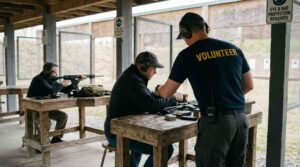
(Image: Created with AI)
What actually works
| Ask people individually. | Not a notice on the board. A conversation, using their name, explaining why you think they would be good at it. The overwhelming majority of volunteers in any organisation started because one person asked them personally. |
| Write the job down. | One page. What the role does, roughly how many hours, who to ring when you are stuck. Most people will say yes to something defined and no to something unbounded, and right now most of our roles are unbounded. |
| Break the big jobs up. | If a position has grown to the point where only one person can do it, that is a sign to split it, not a sign of how indispensable they are. Three people doing a third each is more robust and far easier to recruit for. |
| Give people something small first. | Run one event. Manage one project. A short, finite task with a clear end is how someone finds out they can do it. Almost nobody goes straight from member to treasurer. |
| Hand over before you have to. | The best time for a long serving office bearer to train a successor is while they are still enjoying the job, not in the month before they leave. Sit alongside them for a season. It is the single most valuable thing an outgoing volunteer can do. |
| Write down what is in your head. | Passwords, supplier contacts, the history of the lease, what the council agreed to, where the keys are. If it only exists in one person’s memory, the club does not actually own it. |
A word to the people who have been carrying it
If you have run a branch, a discipline or a range for years, I want to say two things.
The first is thank you, and I mean it in the specific rather than the ceremonial sense. This association functions because of unpaid people doing unglamorous work.
The second is harder. Stepping back is not letting the club down. Staying too long can do more damage than leaving, because it delays the moment the club learns to run without you, and it means that moment arrives as a crisis rather than a plan. The most generous thing a long serving volunteer can do is make themselves unnecessary while they are still there to help.
And to everyone else
If you have been a member for a few years and you have never done anything beyond turning up and shooting, this is the paragraph for you.
You do not need experience. You do not need to have been there a decade. You need to be reliable, willing to learn and prepared to do a small thing properly. Ring your branch and ask what needs doing. Offer to run one event, or to take one job off somebody who has too many.
Every club you have ever enjoyed shooting at exists because someone did that. At some point it has to be our turn.
Until next week: keep ’em on target, in the field and on the range!
Jai Rowell
President — SSAA NSW
WHAT YOU TELL ME MATTERS MOST – ASK THE PRESIDENT
Every week I hear from members and branches, by phone, by email, and standing around at ranges. If you ask me what the most important part of this job is, that is it. Listening to members. Everything else follows from it.
So, I want to open up another avenue. If you have a burning question about SSAA NSW, your membership, your discipline, or where we are heading, send it through to me at jai.rowell@nsw.ssaa.org.au. Each week I will publish a selection of the questions I receive and answer them here, straight, in this column.
No question is too basic and none of them are off limits. If you are wondering about it, chances are a few thousand other members are wondering the same thing
ABOUT THIS COLUMN
Each week I pull up a seat at the bench to talk about what’s happening across SSAA NSW, the wins, the setbacks, what’s on the political radar, and my thoughts on whatever is front of mind, from the matters members are raising with me to whatever is shaping the sport that week. I’ll put our volunteers where they belong, at the front, because they’re the backbone of everything we do, and I’ll back the industry that keeps our sport strong. The promise is in the name: plain talk, no spin, and I’ll always tell it to you straight.