No Good Reason
Firearms shooting is one of the very few sports where being bigger, heavier or stronger confers almost no advantage.
There is no weight division. There is no reach. A fifty kilogram competitor and a hundred kilogram competitor stand at the same line, shoot the same course and are separated by nothing except concentration, technique and practice. At the elite level, men and women have competed against each other directly and women have won.
And yet this sport is still overwhelmingly male. This week I want to talk about why that is, because there is no good reason for it, and a sport that is losing half the population by default has a problem it can actually fix.
The reasons that are usually given
When this comes up, the usual explanations are that women are not interested, or that they do not like firearms.
I do not believe either. The evidence against them is simply what happens at a come and try day, where the split of who enjoys it is nothing like the split of who is a member. Interest is not the bottleneck. Something happens between interest and membership.
What actually gets in the way
I have asked this question of a lot of people, and the answers are remarkably consistent.
Nobody asks them. Invitations go to the blokes at work and the blokes at the pub. A wife or a daughter often finds out what the sport is like only after years of the household revolving around it.
The gear does not fit. Length of pull, stock dimensions, jacket sizing. A rifle set up for a hundred kilogram bloke handles badly for someone smaller, and when it handles badly the beginner concludes they are no good at it rather than that the equipment is wrong.
And the small stuff, which is not small. Whether there are working toilets. Whether the range is somewhere you would be comfortable arriving alone. Whether the first conversation is about shooting or about how nice it is to see a new person at the range.
The barrier is almost never the shooting. It is everything around the shooting.
What clubs can do about it
| Ask directly. | The same principle as everything else in this association. Invite women in your own life, by name, specifically. |
| Fix the gear. | A couple of club firearms set up for smaller shooters, with a shorter length of pull, and a range of jacket sizes. This is a modest amount of money and it removes the single most common practical barrier. |
| Fix the facilities. | Toilets that work, lighting in the carpark, somewhere to change. Unglamorous, and it determines whether people come back. |
| Watch how the first conversation goes. | Talk to a newcomer about shooting. Not about how unusual it is that they are there. |
| Do not water it down. | Nobody wants a special easy version. Same coaching, same standards, same expectations. Being taken seriously is the point. |
| Look at who is on the committee. | If a club’s leadership is entirely one demographic, see what you can do to broaden it. |
Why this is not a side issue
There is a participation argument, and it is strong. A sport with an ageing membership that recruits from half the population is not going to grow how it should, and every other sport in the country worked this out some time ago.
But there is a second argument that matters just as much. The public conversation about firearms in this country is shaped in large part by who people picture when the subject comes up. For as long as that picture is largely male, we are easier to caricature and easier to dismiss. A sport that visibly includes women, families and every other part of the community is a much harder thing to characterise as a fringe.
That is not the reason to do it. It is a consequence of doing it, and it is worth saying out loud.
The honest position
I am not going to stand here and claim this association has solved this, because we have not. We have branches that do it very well and branches that have never thought about it. The variation is enormous and it depends almost entirely on whether one or two people at a club considered the matter.
What I can commit to is that we will treat it as a real priority rather than a line in an annual report, that we will support the branches who want to do something about it, and that we will keep saying it plainly.
It is already starting to happen
Now for the good news. In recent times we have seen a clear and growing trend in female membership and participation across SSAA NSW, and that is something genuinely worth celebrating.
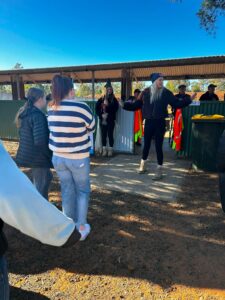
A big part of that has been the SSAA NSW Ladies Try Shooting Days led by one of our Directors, Alison Worldon, and our fantastic staff. The Try Shooting Days give women a relaxed, welcoming introduction to the sport, with experienced coaching, the right equipment and a safe, supportive environment. No experience is needed and nobody is expected to know what they are doing when they arrive. That is the whole point.
Just as important are the days run by our branches. A growing number of branches have taken the initiative to organise their own ladies’ days, and these are often the most effective of all, because the women who come along are meeting the very people they will shoot with if they decide to join. To every branch that has put one on, thank you. To those that have not yet, the association is ready to help you get one off the ground.
The results speak for themselves. Plenty of women who come along for a first go come back for a second, and more of them are going on to become members. It proves the point I made earlier: interest was never the problem. Give people a genuine invitation and a good first experience, and they stay.
Until next week: keep ’em on target, in the field and on the range!
Jai Rowell
President — SSAA NSW
Have your say: Draft Firearms Regulation survey
SSAA NSW is preparing a submission on the NSW Government’s draft firearms regulation, and wants it to reflect the real-world experience of licence holders across the state. Every response helps show Government how the proposed changes would affect members, branches, clubs and businesses.
The survey takes about 20 minutes, and you only answer the sections that apply to your licence. It is anonymous and voluntary, and it closes at 11.59pm on Wednesday 25 November 2026.
CLICK HERE TO COMPLETE THE SURVEY
CLICK HERE FOR MORE INFORMATION
Please share it with fellow members so every voice is counted.
WHAT YOU TELL ME MATTERS MOST – ASK THE PRESIDENT
Every week I hear from members and branches, by phone, by email, and standing around at ranges. If you ask me what the most important part of this job is, that is it. Listening to members. Everything else follows from it.
So, I want to open up another avenue. If you have a burning question about SSAA NSW, your membership, your discipline, or where we are heading, send it through to me at jai.rowell@nsw.ssaa.org.au. Each week I will publish a selection of the questions I receive and answer them here, straight, in this column.
No question is too basic and none of them are off limits. If you are wondering about it, chances are a few thousand other members are wondering the same thing
ABOUT THIS COLUMN
Each week I pull up a seat at the bench to talk about what’s happening across SSAA NSW, the wins, the setbacks, what’s on the political radar, and my thoughts on whatever is front of mind, from the matters members are raising with me to whatever is shaping the sport that week. I’ll put our volunteers where they belong, at the front, because they’re the backbone of everything we do, and I’ll back the industry that keeps our sport strong. The promise is in the name: plain talk, no spin, and I’ll always tell it to you straight.