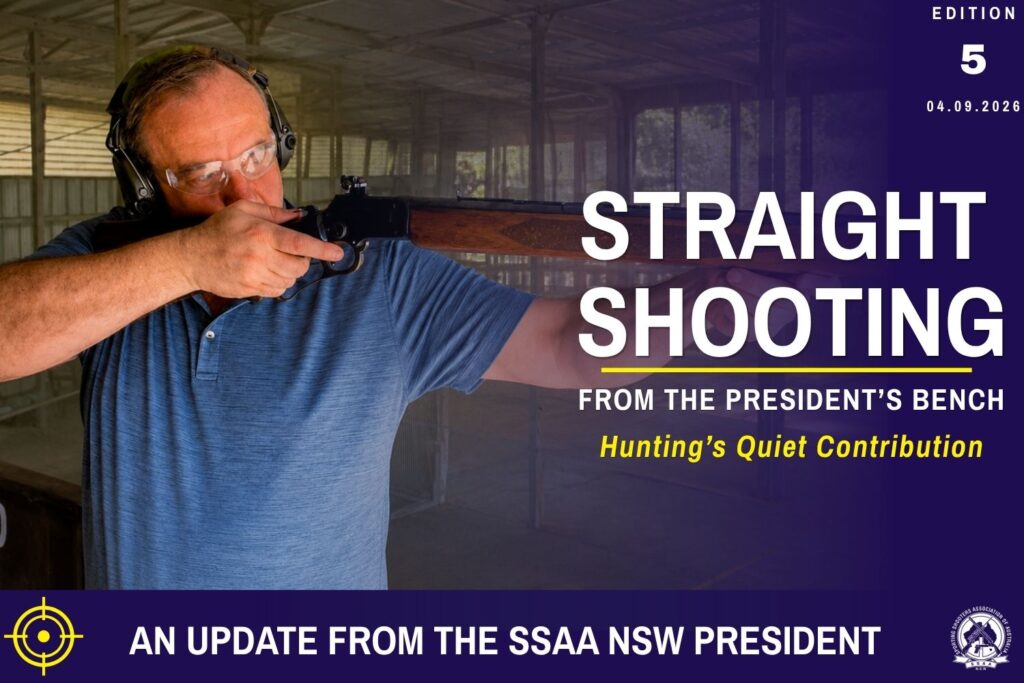
Hunting’s Quiet Contribution
Of everything our members do, hunting is the least understood by people outside the sport and I would argue, the most undervalued.
It is worth setting out plainly what hunting actually delivers in New South Wales, because the picture is a genuinely good one. It supports regional communities, it does real work in protecting country and agriculture, and it puts food on tables that has never seen a feedlot or a truck. Very few pastimes can claim any one of those things. Ours claims all three.
WHAT IT MEANS TO A COUNTRY TOWN
Hunting is a significant economic activity in this state, and the numbers are not small ones.
The most recent departmental study estimated the contribution of recreational hunting at $509 million to the New South Wales economy. In 2024-25, more than 68,000 permits were issued to hunt in our State Forests, producing close to 75,000 hunting days; an increase of around ten per cent on the year before. Hunting is not in decline in this state. It is growing.
More importantly, look at where that money lands. It does not accumulate in the Sydney CBD. It is spent at the servo on the highway, the bakery on the main street, the pub with rooms upstairs, the tyre place, the co-op, the caravan park. It goes to towns that have watched a great many other industries leave, and it arrives in the off-season when tourists do not.
Every member who fills a tank, buys a counter meal and books a night’s accommodation in a rural and regional town is doing something quietly useful for that community. Most would never think to describe it that way.
WORK THAT NEEDS DOING
Australia has an invasive animal problem of extraordinary scale. The Australian Bureau of Agricultural and Resource Economics and Sciences (ABARES) puts the cost of vertebrate pests to Australian farmers at close to a billion dollars each year. Feral deer alone were assessed at over $91 million nationally in a single year, most of it agricultural losses. Rabbits run to as much as $197 million annually in losses and control costs. Foxes and feral cats sit behind a long list of native species that no longer exist.
None of that is abstract to anyone who has spent time on the land. It is pasture destroyed, watercourses fouled, crops flattened, lambs taken, and native animals eaten out of almost existence.
Managing it requires everything; coordinated government programs, professional operators, landholder effort, and volunteers. We are a large, skilled, insured and available workforce that complements it; and there are simply not enough professionals in this country to do the job without us as volunteers.
SSAA NSW has also previously worked directly with Local Land Services on structured wild deer management, developing protocols and accreditation covering marksmanship, mapping and navigation. That is what serious conservation partnership looks like; not a slogan, but agreed plans, trained people and recorded outcomes.
The same is true of the Supplementary Pest Control program, where our accredited volunteers work alongside the National Parks and Wildlife Service (NPWS) to reduce feral animals in national parks and reserves. It began as a three-year trial, was independently reviewed, and was continued and expanded on the strength of that evidence. Volunteers are assessed and accredited before they set foot in a park, and every operation is planned and supervised by NPWS. It is now a standing part of this state’s pest management effort, and it exists because our members proved they could do the work properly. It is a tool in the tool belt among many other activities that we all do to assist.
Which brings me to a request. If you undertake this work, record it and report it. Not because anyone enjoys paperwork, but because the value of what our members contribute is only visible when it is counted. A logged job is worth ten anecdotes.
THE BEST MEAT IN THE COUNTRY
Then there is the part that first drew many of us in, and still does.
A wild animal has lived its entire life on its own terms, on a varied natural diet, across country it chose. It has never been confined, transported, or held in a yard. Taken cleanly by a competent hunter, it is dispatched in the place it lived, without any of the stress that precedes the alternative.
The result is meat that is lean, free-range in the truest sense of a much-abused term, and about as low in food miles as food gets. Venison, wild goat, pork and game birds are outstanding eating, and it is a small tragedy how unfamiliar most Australians are with them.
There is also an ethic here that predates any of us: you use what you take. Not the prime cuts with the rest left behind; the whole animal, properly handled in the field, butchered with care, and shared. The hunters I most respect are the ones whose freezers feed several households besides their own.
WHAT YOU CANNOT PUT A FIGURE ON
Finally, the part no economist will ever capture.
Hunting takes people into country most Australians will never see, and it teaches a way of being in it that cannot be learned from a car window; reading sign, moving quietly, sitting still, being patient, being wrong, coming home with nothing and going back anyway.
It teaches young people exactly where food comes from, which is knowledge our society has managed to mislay in about two generations. It builds a respect for the animal that people who have never hunted routinely assume is absent, and which is in fact the whole foundation of the thing.
And it holds our Code of Practice at the centre of it; safe, ethical, humane, lawful. That is not a constraint on hunting. It is what makes us hunters.
FINALLY
The next time somebody asks you what hunting is for, you have a decent answer; half a billion dollars into this state’s economy, real protection for agriculture and native wildlife, and some of the best and most honestly obtained food in the country.
We do not need to be defensive about any of it. We just need to keep doing it well, keep recording what we do, and keep bringing the next generation along.
Until next week: keep ’em on target, in the field and on the range!
Jai Rowell
President — SSAA NSW
WHAT YOU TELL ME MATTERS MOST – ASK THE PRESIDENT
Every week I hear from members and branches, by phone, by email, and standing around at ranges. If you ask me what the most important part of this job is, that is it. Listening to members. Everything else follows from it.
So, I want to open up another avenue. If you have a burning question about SSAA NSW, your membership, your discipline, or where we are heading, send it through to me at jai.rowell@nsw.ssaa.org.au. Each week I will publish a selection of the questions I receive and answer them here, straight, in this column.
No question is too basic and none of them are off limits. If you are wondering about it, chances are a few thousand other members are wondering the same thing
ABOUT THIS COLUMN
Each week I pull up a seat at the bench to talk about what’s happening across SSAA NSW, the wins, the setbacks, what’s on the political radar, and my thoughts on whatever is front of mind, from the matters members are raising with me to whatever is shaping the sport that week. I’ll put our volunteers where they belong, at the front, because they’re the backbone of everything we do, and I’ll back the industry that keeps our sport strong. The promise is in the name: plain talk, no spin, and I’ll always tell it to you straight.