Somewhere to Shoot
You can have the best association in the country, the finest coaching, the most welcoming branch and a queue of people wanting to join. If there is nowhere to shoot, none of it matters.
Ranges are the foundation everything else sits on, and they are getting harder to build and harder to keep. This week I want to explain why, and what we are doing about it.
The squeeze
The pressure on ranges comes from several directions at once, which is what makes it difficult.
The first is simply the city arriving. A range that was established decades ago on the edge of nowhere now has housing at the fence line, because Sydney and every regional centre in this state have kept growing outwards. The range did not move. The complaints did not exist when it was built. But new neighbours bring new expectations, and an activity that was unremarkable for forty years becomes contentious in five.
The second is land cost and land availability. A range needs area, and area near people is expensive. Many of our clubs sit on leased land, and when a lease comes up for renewal the numbers can change dramatically or the landholder can simply decide to do something else.
The third is the approvals environment. Establishing a new range means environmental assessment, noise assessment, lead management, traffic, bushfire, cultural heritage, and often a public exhibition process where anyone can object. None of those requirements is unreasonable on its own. Together they represent years of work and a substantial amount of money before a single shot is fired. If the range is to be an indoor one then the requirements are even more onerous and of course more expensive.
Ranges take years to build and an afternoon to lose.
What a range actually is
Part of our difficulty is that the people deciding these questions often do not know what they are looking at.
A properly run range is one of the most controlled environments you will find anywhere in community sport. There are range officers with defined authority. There are standing orders. There is a safety template designed by people who do this professionally, with backstops and danger areas calculated rather than guessed. There are records, inductions and supervision requirements. Very few sporting facilities of any kind operate under that level of discipline.
What SSAA NSW is doing
Collectively, we are the largest owner and operator of shooting ranges in the southern hemisphere, and that carries an obligation to be good at this rather than merely large.
We continue to invest in securing long term tenure over the ground we use, because a lease with a real term on it is worth more to a branch than almost anything else we can provide. We support branches through approvals processes, which are frankly beyond what a volunteer committee should be expected to navigate alone. We are working to lift the consistency of range documentation and compliance across our facilities, so that a visiting regulator finds the same standard everywhere. And we are building the new facilities that the next generation will use, including the range at Dubbo.
I would rather report this plainly than oversell it. Progress in this area is measured in years, and there are projects that have been in train longer than I have been on the board.
SSAA NSW continues to work on new range opportunities; speaking with various levels of government authorities, analysing the market and of course hearing from Branches.
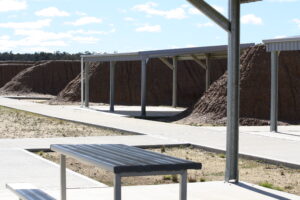
(Dubbo Range)
What branches and members can do
| Be a good neighbour before you need to be. | The clubs that survive the arrival of housing are almost always the ones that were already known locally. Invite the neighbours. Talk to the council. Turn up to the local show. Goodwill is cheap to build in advance and impossible to manufacture during an objection period. |
| Keep your paperwork immaculate. | Range approvals, safety templates, incident records, maintenance logs. When a facility is challenged, the paperwork is the defence. A club that cannot produce it is in trouble regardless of how safely it has actually operated. |
| Tell us early. | If your lease is coming up, if a development application has gone in nearby, if council has started asking questions, contact us at the start and not at the crisis. Early is where we can help. Late is where we write letters. |
The long view
Every range in this state exists because somebody years ago did the unglamorous work of finding land, arguing with authorities, raising money and pouring concrete. Most of those people never got thanked properly, and some of them never shot on the finished facility.
That is the standard we are working to. Not what we can open this year, but what is still standing and still welcoming new shooters in thirty years. If we get that right, most of the rest takes care of itself.
Until next week: keep ’em on target, in the field and on the range!
Jai Rowell
President — SSAA NSW
WHAT YOU TELL ME MATTERS MOST – ASK THE PRESIDENT
Every week I hear from members and branches, by phone, by email, and standing around at ranges. If you ask me what the most important part of this job is, that is it. Listening to members. Everything else follows from it.
So, I want to open up another avenue. If you have a burning question about SSAA NSW, your membership, your discipline, or where we are heading, send it through to me at jai.rowell@nsw.ssaa.org.au. Each week I will publish a selection of the questions I receive and answer them here, straight, in this column.
No question is too basic and none of them are off limits. If you are wondering about it, chances are a few thousand other members are wondering the same thing
ABOUT THIS COLUMN
Each week I pull up a seat at the bench to talk about what’s happening across SSAA NSW, the wins, the setbacks, what’s on the political radar, and my thoughts on whatever is front of mind, from the matters members are raising with me to whatever is shaping the sport that week. I’ll put our volunteers where they belong, at the front, because they’re the backbone of everything we do, and I’ll back the industry that keeps our sport strong. The promise is in the name: plain talk, no spin, and I’ll always tell it to you straight.