Talking to Your MP
For a good part of my working life I was on the receiving end of the letters, the emails and the phone calls. First as a member of parliament, then as a minister, and before that as a chief of staff and adviser. I have read thousands of them. Some changed my thinking. Most did not, and the difference had very little to do with how strongly the writer felt.
This week I want to share what I learned on the other side of the desk, because every one of our 75,000 members has a local member of parliament, and very few of us use that relationship as well as we could.
What actually happens to your letter
When you write to your MP, your letter does not land on their desk first. It lands with a staff member in the electorate office, who reads it, logs it and decides what happens next.
If it is a form letter, identical to two hundred others, it is counted. The count matters, but that is all that happens to it. If it is personal, local and specific, it is read properly, and there is a real chance it goes to the member with a note attached.
That note is the thing you are trying to earn. A staffer writes it when a letter tells them something they did not already know, about somebody in their own electorate.
A form letter gets counted. A personal letter gets read.
What makes a letter work
- Be a constituent first. Put your suburb or town in the first line. An MP’s first question is always whether you live in their electorate, and if the answer is not obvious, the letter drops down the pile.
- Keep it to one page. Nobody in an electorate office has time for four pages. One issue, stated plainly, with your reasons and what you are asking for.
- Tell them who you are. Your job, your branch, how long you have shot, whether you hunt on a local property or compete at a local range. This is what turns an interest group into a person.
- Ask for something specific. A meeting. A question raised with the minister. A position stated in the chamber. A letter that only expresses a view gets an acknowledgement. A letter that asks for something gets a response.
- Be courteous, always. I cannot stress this enough. An abusive letter does not register the depth of your feeling. It gets filed, and it is sometimes quoted back at our entire community as evidence of who we are. In fact, the office will flag your name in their database, so next time you send something in they know and have a negative view of you straight away.
The meeting
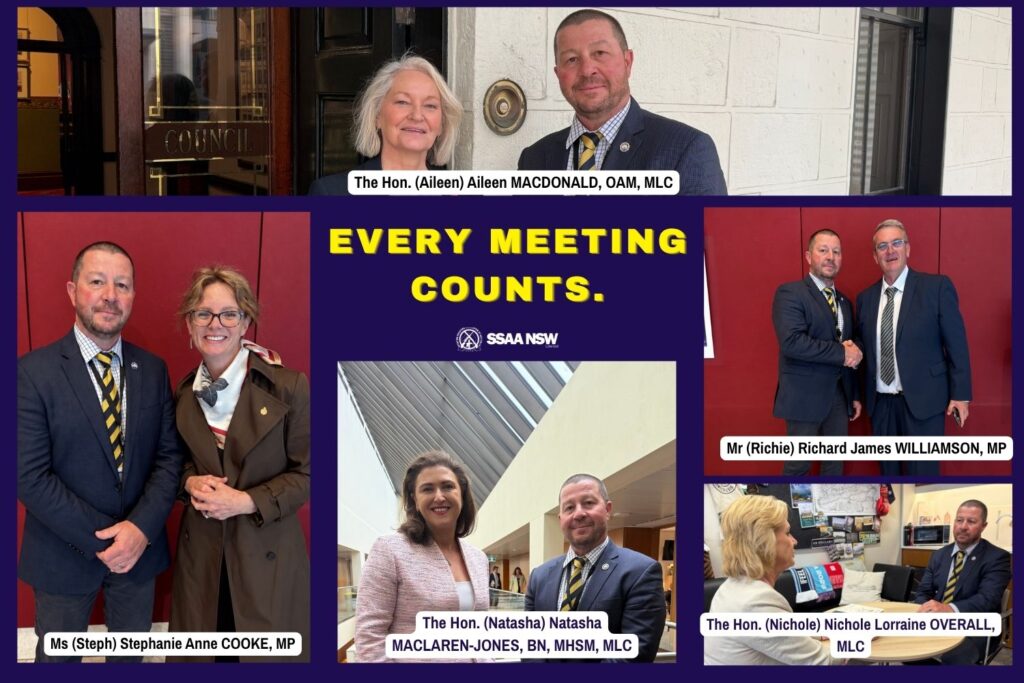
If you can get a meeting, take it. Twenty minutes in person is worth more than a year of emails.
Go with one or two others at most, ideally from the same electorate. Agree beforehand who will speak and what the single point is. Bring a one-page summary to leave behind. Explain what the policy means for real people in their electorate, not for firearms owners in the abstract.
Listen as much as you talk. Ask them what they are hearing, what pressures they are under and what would help them support you. You will learn more from that question than from anything you say.
And follow up. A short thank-you email the next day, restating the point and the ask, is the single most neglected step in this whole process and one of the most effective.
Every side of the chamber
Write to your member whoever they are and whatever party they belong to. Government members, opposition members and crossbenchers all have a vote and a voice, and many of them are engaging with our issues in good faith.
It is tempting to write only to those we expect to agree with us. That is exactly backwards. The member who has never heard from a licensed shooter in their electorate is the one who most needs to.
And do not wait for a crisis. An MP who first hears from you on the day a bill is introduced will treat you as a lobbyist. One who has met you twice at the local show and once at your range will treat you as a constituent. Those are very different conversations.
Invite them out
The most persuasive thing you can offer an MP is not an argument. It is a morning at your range.
Many members of parliament have never seen a properly run range. They have never heard range commands, watched a safety briefing or seen a junior coached through their first shot. Invite them to your branch, give them a proper tour and introduce them to your members. If they want to have a go under supervision, even better.
I have seen a single visit change how an MP talks about our sport for years afterwards.
Why it matters
Firearms policy in this state will be decided by 93 members of the Legislative Assembly and 42 members of the Legislative Council. Every one of them has licensed shooters in their electorate or constituency, and most of them have no idea how many.
We can change that. Not with volume, and not with anger, but with 75,000 ordinary people who are willing to write one good letter and ask for one meeting.
If you would like help preparing for a meeting with your local member, the state office is happy to assist.
Until next week: keep ’em on target, in the field and on the range!
Jai Rowell
President — SSAA NSW
WHAT YOU TELL ME MATTERS MOST – ASK THE PRESIDENT
Every week I hear from members and branches, by phone, by email, and standing around at ranges. If you ask me what the most important part of this job is, that is it. Listening to members. Everything else follows from it.
So, I want to open up another avenue. If you have a burning question about SSAA NSW, your membership, your discipline, or where we are heading, send it through to me at jai.rowell@nsw.ssaa.org.au. Each week I will publish a selection of the questions I receive and answer them here, straight, in this column.
No question is too basic and none of them are off limits. If you are wondering about it, chances are a few thousand other members are wondering the same thing
ABOUT THIS COLUMN
Each week I pull up a seat at the bench to talk about what’s happening across SSAA NSW, the wins, the setbacks, what’s on the political radar, and my thoughts on whatever is front of mind, from the matters members are raising with me to whatever is shaping the sport that week. I’ll put our volunteers where they belong, at the front, because they’re the backbone of everything we do, and I’ll back the industry that keeps our sport strong. The promise is in the name: plain talk, no spin, and I’ll always tell it to you straight.